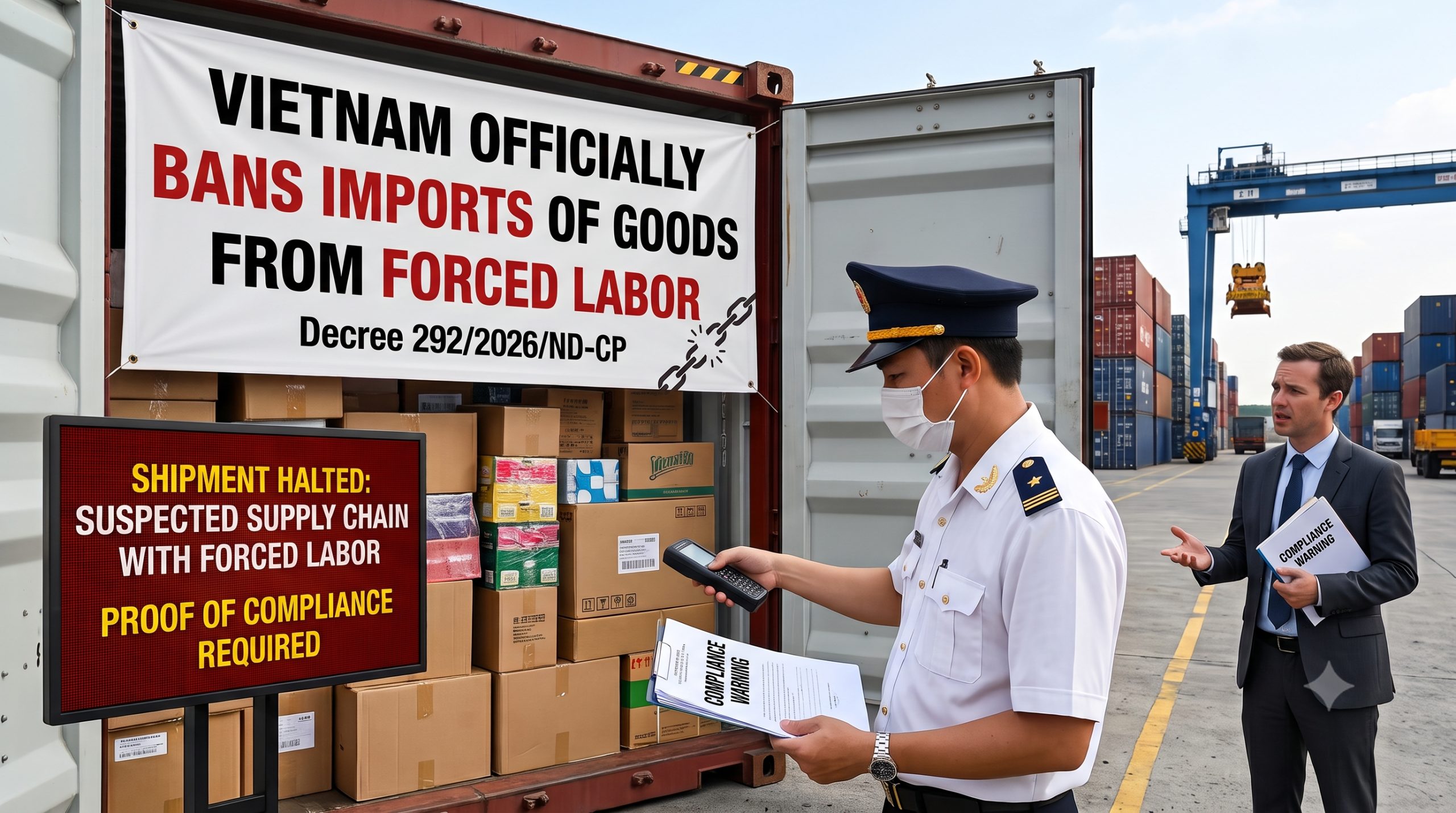
Vietnam’s international trade legal framework has recently marked a significant turning point with the issuance of Decree 292/2026/ND-CP (effective September 5, 2026, replacing Decree 69/2018/ND-CP).
The new regulation officially bans the importation of goods mined, produced, or manufactured, wholly or in part, by forced labor. This is a clear signal that Vietnam is steadily aligning with international standards on Responsible Business Conduct (RBC) and sustainable supply chain management.
This trend is consistent with the stringent requirements already implemented in key export markets such as the US, the EU, the UK, and Canada, where regulatory bodies are increasingly tightening controls over human rights violation risks throughout the entire supply chain.
For foreign suppliers providing raw materials, components, or finished goods to the Vietnamese market, this new regulation introduces substantial legal challenges and rigorous compliance requirements.
1. Expanded Supply Chain Accountability
- Not limited to final products: The regulation applies to goods manufactured “wholly or in part.” This means that even if a foreign supplier only sells raw materials, components, or semi-finished products, if any tier of their supply chain (tier-2, tier-3) engages in forced labor, the entire shipment faces the risk of being banned from entering Vietnam.
- Shifting the burden of proof: Importing enterprises in Vietnam are now required to conduct human rights due diligence (HRDD) and will inevitably transfer the pressure of auditing and proving compliance upstream to their foreign partners.
2. Legal Risks in International Commercial Contracts
The shift in Vietnam’s import policies necessitates restructuring the terms of international sales contracts:
- Anti-Forced Labor Warranties: Foreign suppliers will be required to include contractual clauses affirming that their production processes strictly comply with International Labour Organization (ILO) standards and Vietnamese laws.
- Penalties & Damages: If a shipment is detained or denied customs clearance by Vietnamese Customs due to suspected forced labor, the foreign supplier faces severe risks: penalty clauses, immediate contract termination, and full compensation for incurred damages (including storage, re-exportation, destruction costs, and losses from the Vietnamese buyer’s production disruption).
3. Auditing & Due Diligence Requirements
- Establishing HRDD Records: Foreign suppliers must proactively build and maintain comprehensive labor due diligence records. This includes labor contracts, payroll records, overtime policies, and certifications confirming the absence of forced or illegal child labor.
- Readiness for Independent Audits: Vietnamese partners or regulatory authorities may request compliance audit reports (ESG Audits) from reputable, independent auditing firms to serve as justification for Customs clearance.
4. Blacklisting Risks & Global Domino Effect
- Enterprise-Level Trade Bans: The consequences extend beyond the financial loss of a single rejected shipment. The foreign supplier’s name could be placed on a high-risk watchlist by Vietnamese authorities, effectively cutting off their access to a market of 100 million consumers.
- Negative Impact on Other Markets: A forced labor violation confirmed by Vietnamese authorities can trigger a chain reaction of investigations from other strict markets (such as the US’s UFLPA or the EU’s CSDDD), causing severe damage to the supplier’s global reputation and business operations.
ACTION PLAN FOR FOREIGN SUPPLIERS
To maintain their market position and ensure smooth trade flows into Vietnam, VILAWCO recommends that foreign suppliers take immediate action:
- Supply Chain Review & Audit: Re-evaluate recruitment and labor management processes within your own facilities and those of your sub-tier suppliers (especially in raw material extraction).
- Transparent Compliance Records: Prepare readily available documentation proving a “clean labor source” for every export shipment destined for Vietnam.
- Contract Review & Amendment: Collaborate with legal experts to update liability exemptions, force majeure clauses, and dispute resolution mechanisms to align with Decree 292/2026/ND-CP.
This article is authored by the Corporate & Compliance Legal Team – VILAWCO.
Connect with VILAWCO
For further advice and assistance, please contact:
VINALAW CONSULTANCY COMPANY LIMITED: VILAWCO – Vững pháp lý, trọn niềm tin
- 24/7 Hotline: 0876 079 899
- Email: info-atty@vilawco.com
- Website: https://vilawco.com/
- Head Office: 115 Street No. 1, Binh Tri Dong Ward, Ho Chi Minh City, Vietnam
- Representative Office: 479/22 Phan Van Tri Street, An Nhon Ward, Ho Chi Minh City, Vietnam
Key Services Provided
-
Corporate & Commercial Law: Enterprise setup, corporate governance, and contract review.
-
Investment & M&A: Investment structuring, regulatory compliance, and licensing.
-
Website & Ad Compliance: Legal audit of digital platforms, promotional campaigns, and online terms.
-
Dispute Resolution: Commercial arbitration and litigation support.
If you are looking to draft a specific legal inquiry, schedule a consultation, or review business terms for VILAWCO, let me know how I can assist you with the content!
VILAWCO looks forward to earning your trust and having the opportunity to cooperate with our valued clients and partners in the future.

Phản hồi gần đây