
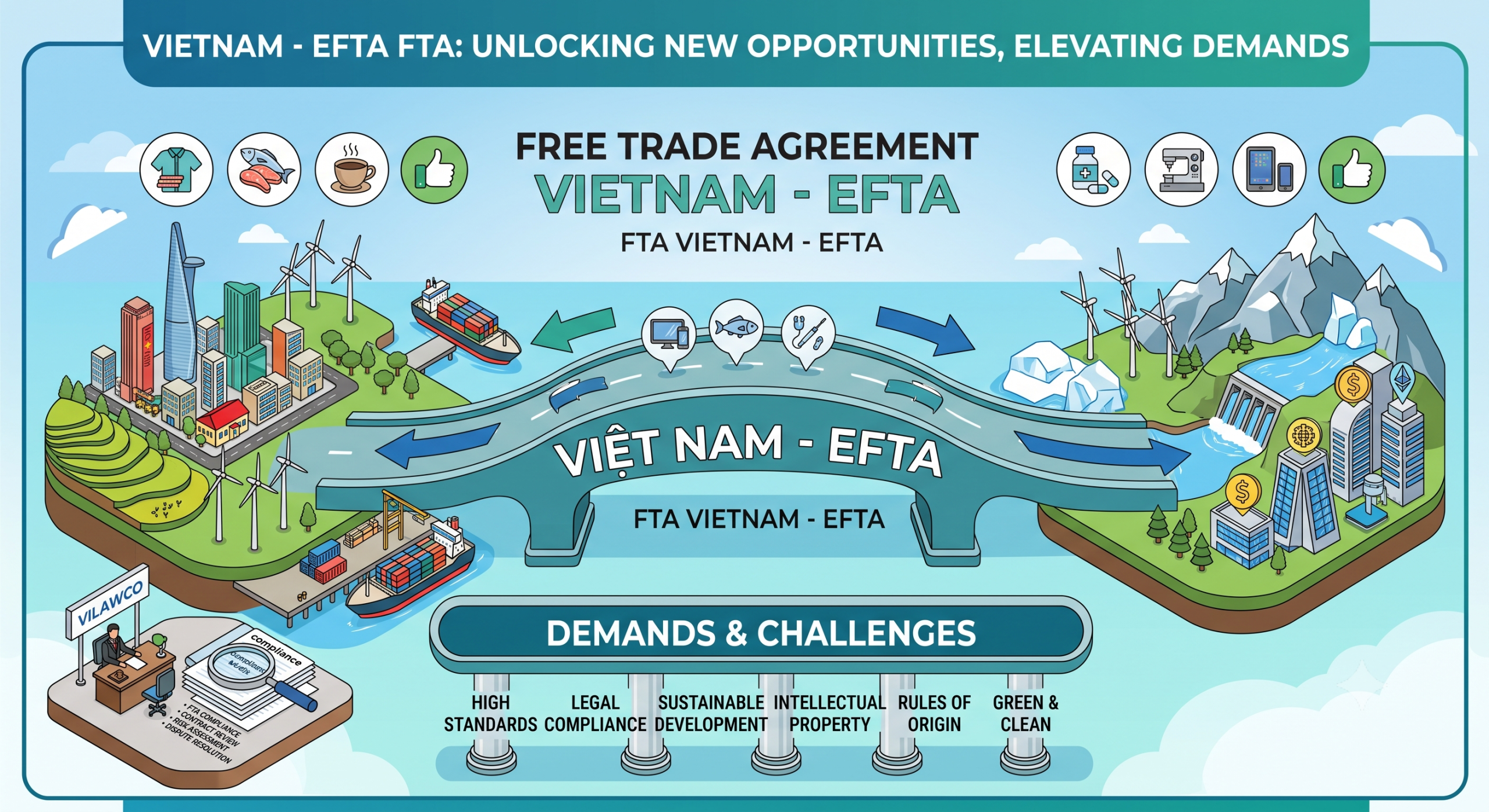
The official conclusion of negotiations for the Comprehensive Free Trade Agreement (FTA) between EFTA and Vietnam marks a significant milestone in shaping the supply chain strategies of Nordic and Central European economies in Southeast Asia. For the EFTA block—a group of high-income nations renowned for advanced technology, robust financial capabilities, and strict sustainability standards—Vietnam is far more than a consumer market. It represents a strategic hub within the global value chain.
1. EFTA’s Perspective: Why Vietnam?
Amid shifting geopolitics and the global restructuring of supply chains (China+1, China+N), EFTA nations evaluate Vietnam through three core lenses:
-
Regional Gateway to ASEAN: Leveraging Vietnam’s extensive FTA network and strategic geographic position, EFTA corporations can use the country as a springboard to access the broader Southeast Asian market.
-
Impressive Bilateral Trade Footprint: Bilateral trade reached EUR 4.8 billion in 2025 (excluding Swiss gold trade). Although EFTA runs a trade deficit with Vietnam (EUR 2.5 billion), this highlights high economic complementarity rather than direct competition.
-
Destination for High-Quality FDI: As Vietnam shifts from low-cost manufacturing toward sustainable development, it creates substantial demand for EFTA’s core strengths: renewable energy, fintech, pharmaceuticals, maritime tech, high-tech agriculture, and circular economy solutions.
2. Key Opportunities for EFTA Businesses and Investors
The comprehensive FTA provides distinct advantages to accelerate EFTA’s commercial footprint in Vietnam:
A. Expanding High-Value Goods & Services Exports
-
Switzerland & Liechtenstein: Growth opportunities for high-value products such as pharmaceuticals, medical devices, precision machinery, specialty chemicals, luxury timepieces, and financial, banking, and insurance services.
-
Norway & Iceland: Expanded access for cold-water seafood (salmon, cod), maritime technology, cold-chain logistics, and sustainable ocean resource management solutions.
B. Breakthroughs in Green Foreign Direct Investment (Green FDI)
-
Energy Transition & Marine Economy: Strong potential for Norwegian investments in offshore wind projects, port infrastructure, and green transition initiatives.
-
Processing Technology & Geothermal Energy: Iceland can transfer advanced seafood processing, post-harvest preservation technologies, and geothermal energy exploitation.
C. Public Procurement & Investment Protection
-
Commitments to open public procurement markets, backed by a transparent investment framework, provide EFTA conglomerates with greater confidence to bid on large-scale infrastructure, energy, and digital transformation projects in Vietnam.
3. Challenges Facing EFTA in Entering the Vietnamese Market
Despite significant potential, EFTA investors and businesses face several operational barriers and structural risks:
-
ESG & Sustainability Compliance Gaps: EFTA’s stringent standards regarding carbon emissions, social responsibility, and labor conditions may encounter operational hurdles in Vietnam due to lagging local infrastructure and supply chains that are not yet fully “green-certified.”
-
Regulatory Environment & Administrative Procedures: Complex investment licensing, capital transfer regulations, and the limited predictability of certain local policy implementations remain key concerns for Swiss and Nordic investors.
-
Intellectual Property Rights (IPR) Enforcement: EFTA holds valuable patents, industrial designs, and premium brands. While Vietnam’s IPR framework has improved, stronger enforcement mechanisms are essential to mitigate risks of counterfeit goods and patent infringement.
-
Intense Competition from Existing FTA Partners: Established players from the EU (via EVFTA), Japan, South Korea, and CPTPP member states have deep roots in Vietnam. EFTA firms must identify niche markets and technological breakthroughs to differentiate themselves.

4. Implementation Strategy for EFTA: From Commitments to Reality
To maximize the agreement’s benefits and achieve sustainable market entry, the EFTA block should execute a phased strategy:
1. Build Flexible and Integrated Supply Chains
Rather than treating Vietnam solely as a sales destination, EFTA investors should establish R&D hubs and lean manufacturing units in Vietnam to leverage tariff preferences when exporting to adjacent ASEAN and CPTPP markets.
2. Drive Capacity-Building Partnerships & Tech Transfer
EFTA’s success in Vietnam hinges on empowering local suppliers. EFTA conglomerates should actively assist Vietnamese enterprises in standardizing operations and obtaining green certifications, building compliant local supply chains from the ground up.
3. Proactively Mitigate Legal and Dispute Risks
EFTA businesses should collaborate closely with trade offices and business associations (e.g., SwissCham, EuroCham) to navigate tariff reduction schedules. Commercial contracts should explicitly incorporate international arbitration clauses and Investor-State Dispute Settlement (ISDS) mechanisms to safeguard assets.
4. Target Premium Segments & Sustainable Branding
EFTA firms should refrain from price-based competition and instead position their offerings around superior quality, transparency, reliability, and sustainability—values increasingly prioritized by Vietnam’s expanding middle class and leading domestic enterprises.
Strategic Takeaway: “From EFTA’s vantage point, Vietnam is not just a consumer market of 100 million people, but a strategic partner for building green, high-value, and resilient supply chains in Asia.”
Connect with VILAWCO
For further advice and assistance, please contact:
VINALAW CONSULTANCY COMPANY LIMITED: VILAWCO – Vững pháp lý, trọn niềm tin
- 24/7 Hotline: 0876 079 899
- Email: info-atty@vilawco.com
- Website: https://vilawco.com/
- Head Office: 115 Street No. 1, Binh Tri Dong Ward, Ho Chi Minh City, Vietnam
- Representative Office: 479/22 Phan Van Tri Street, An Nhon Ward, Ho Chi Minh City, Vietnam
Key Services Provided
-
Corporate & Commercial Law: Enterprise setup, corporate governance, and contract review.
-
Investment & M&A: Investment structuring, regulatory compliance, and licensing.
-
Website & Ad Compliance: Legal audit of digital platforms, promotional campaigns, and online terms.
-
Dispute Resolution: Commercial arbitration and litigation support.
If you are looking to draft a specific legal inquiry, schedule a consultation, or review business terms for VILAWCO, let me know how I can assist you with the content!
VILAWCO looks forward to earning your trust and having the opportunity to cooperate with our valued clients and partners in the future.

Phản hồi gần đây